

Dolly Meckler: I'm into showing people things that are right under their nose
A conversation with the social media strategist

Welcome to Human Pursuits, the column that features need-to-know names and stories in media and other creative spaces. Today, social media strategist and consultant Dolly Meckler on Substack brand building, DIY media careers, long-distance walking in LA, and uncovering an underreported collection at The Met.
Nobody walks in Los Angeles.
Alright, maybe they walk along the Santa Monica Pier, or the Venice canals, or the trails snaking up and down Runyon.
But they don’t walk in the city. Not like they do in New York. Shlepping from A to B. Logging miles in a town where every street is famously a runway.
To walk in LA is a sign of utter madness or total brilliance.
Speaking with Dolly Meckler, I’m led to believe it’s the latter.
In true millennial multi-hyphenate fashion, Dolly’s career defies simple explanation. She is a social media strategist, but also “The People’s Journalist”, a solo content creator, but also a close collaborator with Lena Dunham , who recently referred to her as a “surprising and sacred brain twin.”
She writes, she edits, she films, she observes. She also walks. On both the East and West coasts. She is a bi-coastal bipedal.
With Dunham’s memoir, Famesick, still atop the New York Times best-seller list (it sold 60,000 copies its first week, and landed at #1; as of writing, it’s slipped slightly to #5), the pair have been praised for their comprehensive and contemporary approach to book marketing, which saw Lenny making inroads via her Substack newsletter.
While it’s tempting to assume success here was inevitable—Dunham’s popularity has only grown in the years since Girls was on air—the truth is, it’s difficult to make things look this easy. You need to be a real pro. A “viral genius", some might say.
Though she clearly has “motion,” I suspected Dolly might also have some insights into the strange world of newsletters, content, and media.
And so we had much to discuss.
Our edited and condensed conversation touched on her unusual breakfast, walking as anthropology, her newsletter, Scrollodex, and more.
ES: It’s mid-morning in New York, but early morning here in Vancouver. And so I’m wondering what you had for breakfast today.
DM: Oh my God. Okay. Wow. I had lentils for breakfast. It’s really not my typical thing, but I had lentil soup in my fridge, and that’s what I went for. I wanted something warm. I usually eat oatmeal every morning, but it was there, and I just heated it up.
ES: Soup for breakfast is a big, bold choice.
DM: No, it’s crazy! It’s crazy, and I’m so embarrassed that that’s what happened today. But that is what I had.
ES: Was it homemade or takeout?
DM: Homemade.
ES: Dolly’s own recipe, or did you pull from somewhere?
DM: I made it up. It’s vegetables and lentils. It’s a hearty soup… I love something warm in the morning, so I usually love oatmeal. I truly eat oatmeal every single day, but today I thought, “I’m just gonna do that.”
ES: Is it nice in New York right now? Vancouver had summer weather yesterday, and now it feels like winter.
DM: Exact same thing happening here. Yesterday was warm.
ES: I always joke that my wife is like a gecko. She loves warm weather. Are you similar?
DM: No. I like it all. I lived in LA for 10 months from 2019 to 2020, and the constant warmth kind of freaked me out. I need the seasons. I want it to be cold when it’s supposed to be cold, I want it to be warm when it’s supposed to be warm. I like the transition.
ES: Plus, you get to wear those fun autumnal or spring layers.
DM: Totally.
ES: What brought you to Los Angeles for that brief amount of time?
DM: I had left my job. I was working at YouTube, running their brand social. I was in New York, and I quit and decided to go freelance. I didn’t have anything lined up, but before that, I had worked at HBO for many years, so I had a lot of contacts in entertainment, and that was my background. I had been to LA so many times for work over the years, and I thought, “Where’s the best place to be when you don’t have a job? Los Angeles.” Laughs.
So, I went out to LA. Everyone’s working on something creative. I knew a lot of people out there, and I decided to just really shake up my life and try to do something new, because I’m from New York.
ES: Did you leave LA for pandemic reasons? Or were you over it?
DM: I think it was a little bit of both. I probably would have stuck it out longer had it not been the pandemic, but the pandemic just made it so you couldn’t even leave the house. I wasn’t able to leave my apartment. I was living with my best friend from high school, and we were having so much fun, but I couldn’t even see LA. I wasn’t seeing people. I thought, “What’s the point of being here? I may as well just go back and be closer to my family.”
I call it my “study abroad” in LA because it was truly such a cultural experience. The way people correspond or act and do things was just so different from what it is in New York. I’m a New Yorker through and through, and the hustle is different on the West Coast.
ES: I was gonna say, we’re more laid back, hey?
DM: Yeah, it just wasn’t for me. I have so many people I love in LA, and there’s lots to love, but there are a lot of things I really didn’t like, too. I’m happy I got to learn about it.
ES: Did you have a car at the time?
DM: Everyone thinks my lack of car was the problem and that I would have loved it a lot more had I had a car. I am telling you, no, it was great not to have a car. I was the crazy person who walked everywhere, and I really liked that. I learned where I was and understood how far things were. I walked for hours. I couldn’t believe that nobody was walking anywhere. There are people who won’t walk three blocks in LA. I just couldn’t believe that. Anytime I had the opportunity to walk, I would.
I lived in West Hollywood, which is pretty walkable compared to a lot of other cities in LA. Probably the furthest I had walked was from West Hollywood to Beverly Hills, which would take an hour and a half. But I go on long walks in New York, too, for exercise, so I’ll go to the park, and I’m walking for an hour or an hour and a half sometimes. To me, it was like, "Alright, I’m already used to walking these long distances, what’s the difference?” The difference is that there’s nobody around, and you are the crazy person just walking on the little teeny sidewalk that no one else has probably ever walked on before.
I used to carry sneakers around with me because I would have a lot of meetings. I used to document myself walking around LA, showing that there was no one around and also that there were no trash cans anywhere. I would pack a yogurt as a snack, and I would have nowhere to throw it away if I ate it on a bench or something. It was just a funny thing.
ES: When you’re walking in New York, are you working and taking calls, or is that Dolly time?
DM: It’s evolved over the years. Now that I have a son, my life is very different in terms of how much free time I have. Before, I used to be able to wake up, go on a walk in the morning, and that would be my time, listening to a podcast. I don’t do that anymore; now I’m waking up, and I’m with my son. I also don’t have a commute at the moment, so when I’m walking, I’m usually going to a specific destination. I’m not really listening to things on my AirPods. I feel like I’ve really been off my phone lately. Maybe I’ll answer emails or write things in my Notes app that come to me… but I’m not listening to anything. It’s my time to step away from the computer.
Culture can start literally on the streets.
ES: There’s a girl on TikTok who does these long-ass walks in New York City. She calls them Urban Hikes. She’ll walk from Brooklyn to Manhattan, and she’ll pick these roundabout ways to get there. It seems like something you might be into.
DM: I’ve done that before. My now-husband used to live in Park Slope in Brooklyn, and I have walked there before. I think it took me about two and a half hours, maybe. I had the time, and I could do it. I love walking like that. I walked from the top of Manhattan to the bottom many years ago.
ES: So you’re not really working while you walk, but does walking inspire your work?
DM: It’s very important for me. I’m a big observer. I like to take note of things and think, “Oh, that wasn’t there yesterday.” I’m also a big neighbourhood girl. I live on the Upper East Side, and I am a really proud Upper East Sider. When I’m walking around, I see my UPS man and say, “Hey, David.” I see the person on the corner, or I see my mail girl and say, “Hey, Naomi.” I just love the neighbourhood and the people around.
It creatively inspires me—especially for my newsletter, I recap my week, what I’m doing, what I’m seeing, who I’m seeing, and what I’m talking about. Walking around and getting out of my neighbourhood allows me to learn so much information. It is an inspiration for things for me to talk about, and I get inspired to think about new things when I’m on a walk and see something.
ES: You’re new-ish to the newsletter game. I’ve been doing this for a while—five or six years—and I wonder what it’s like to start a Substack right now. Did you feel like you were late to the game?
DM: I decided to do it about a year and a half ago. It was not called Scrollodex, originally; it’s evolved over time. I was actually very embarrassed about it because I felt like, “Oh, everybody’s got their Substack, here I go.” But people are still coming onto Substack just now, and I’ve been here for a year and a half, so there was really nothing to be embarrassed about.
I joined because the first thing I wrote about was a woman I saw on the bus. I take the bus a lot, too. I love the bus. And so I was reading her texts—she was sitting right in front of me—and she had an incredible exchange that I took a photo of and posted on my Instagram, and it went viral. Then I posted it to my feed because people were sharing it… Somebody recognized her, and after it was shared around so many times, we made contact and ended up meeting for coffee. That became my first post–an interview with this woman, who was so hilarious. It turns out she was texting with her daughters. She was so into it; she wasn’t upset at me, she was going along with it, thought it was funny, and felt like, “Oh my God, I feel so seen.” She said, “When you’re an older woman, no one’s paying attention to you anymore,” and it made me happy that people thought it was so funny.
ES: Hearing you say that got me thinking. There’s a bit of a gender gap on Substack in the way men use the platform versus the way women use it. This is a gross oversimplification, but I feel like women can share those sorts of intimate, slice-of-life things, whether it’s an interesting stranger or their skin care routine, but men might be reluctant to do so. It’s like men have self-relegated themselves to writing about finance or AI, and women handle the life and culture stuff. Do you think that’s inherent to the newsletter format?
DM: Wow. I had never thought about it like that. I think men don’t catch up with their friends the way women do, and I think that’s just a conversational thing. That’s maybe the missing link. If men aren’t going to call up a friend just to talk and tell them how they’re doing, why would they do that on the internet? There must be guys that are, though.
ES: I’m sure there are. Again, this is an oversimplification, but it’s just something I’ve noticed and almost envy. I think you’re right that women are perhaps more natural at conversing and establishing that conversational tone. It’s something I always really admire. Sometimes you read these things, and it feels like your best friend is emailing you.
DM: Totally.
ES: You’ve said in other interviews that Substack is a bit of a bubble, and I’d love to talk about that a little more, especially from a strategy perspective. Do you think Substack will be able to crossover and become less insular? Will it have a moment similar to blogging in the early 2000s?
DM: So for context, my background is as a strategist, and I’ve worked mostly in social, but I now say that I really work with brands and talent to help translate who they are into how they show up online—whether that’s through social, a buzzy event that gains recognition or attention, or a partnership or collaboration where you’re exposed to a new audience. Anything that really helps people understand who you are through the internet.
Substack is incredible to me because of how influential it is, and in a way that’s a lot quieter than Instagram or TikTok. It’s not in your face—it’s happening in your inbox, so it’s not something you’re necessarily pressing share on via your social apps. It feels a little bit more intimate, like something I do for myself, and people aren’t seeing what I’m liking or following. It’s not really a conversation driver the way Instagram is. Instagram is trying to be more of a communications app, where it’s one-to-one versus one-to-many, which is why the algorithm is so hard to break through, but it’s really a messaging app. You’re replying to people’s stories and sending posts to your friends that you find funny, but that’s just not the behaviour on Substack… I can read what I’m interested in and leave out what I’m not.
Do I think it has the potential to break through? I do, because Substack is still in its very early days. People can build real businesses and brands off Substack that we’re going to see translated to other places. If you’re a real writer, maybe you’ll then be writing a regular column for the New York Times, or maybe your Substack Lives turn into a video podcast on YouTube or a podcast app. You start appearing in other places, and then maybe you get a brand deal that pops up on your Instagram feed. I can see it becoming bigger than what it is…
ES: For a long time, there was a perception that most of the people who really pop off on Substack—in terms of generating real revenue or landing on the bestseller list—tend to be people who have audiences they are importing from other places. Do you think the app makes it possible for someone to launch and build a platform directly there? Have we seen our first Substack celebrity? Maybe Emily Sundberg ?
DM: I would say Emily is a Substack influencer, though, not in the way we typically think about influencers. She’s a really good example of what you can build on the app, and she holds a lot of influence on the platform.
I really like a newsletter called Rich People Shit by Carson Griffith . She’s a journalist who writes about rich people's things. I think that’s such a niche, specific topic that you can build a real world off of. It’s so specific but also so general, and there’s a voyeuristic element to it, so whether you are rich or an aspiring rich person, it’s interesting to you. Her stuff is really interesting… Liana Satenstein is als amazing. She’s so funny, smart, and obsessive about things, which makes for a really interesting perspective. Emilia Petrarca is also really thorough in how she writes.
I’m really into showing people things that are right underneath their noses.
ES: On top of everything else, you do a lot of people-on-the-street interviews. We’ve seen a huge influx of creators with tiny microphones doing that sort of thing, especially in New York. What’s your POV on all this?
DM: I’ve been doing it since 2011. I started a web series when I was in college at Indiana University because I wanted to work in television. I was interviewing for internships at Comedy Central and didn’t end up getting one. They told me it was because I didn’t have enough TV experience, and I thought, “How am I supposed to get TV experience if I can’t get an internship? I’m 19 years old.” So I decided to take matters into my own hands and start my own TV show. I pitched a man-on-the-street style comedy show to the IU TV network. They loved it and told me to go make it. Back in 2011, phones weren’t everything like they are now; you actually needed cameras and editing software. I found another student interested in making movies to film for me, and I taught myself how to use Final Cut and Adobe Premiere by sitting in the computer labs until three in the morning. It was all trial and error, but in the end, I had my show, Hello Dolly. I put it on YouTube and opened a Facebook page to run a rollout campaign, counting down the days to the premiere. People in the frats and sororities would sit around waiting for the YouTube link. It was a slice of life at the school that someone was capturing before Instagram existed.
That series ended up getting me a job after college. I worked at an ad agency, then in the mailroom at WME, and finally at HBO. I got that job because I had been sending my links to a person who ran social at Bravo. He eventually moved to HBO and called me up to run social for Game of Thrones. I continued to make Hello Dolly in New York after school. I still do it for the Met Gala, which is really interesting to me because people have cool things to say who don’t usually get the spotlight. Like, culture can start literally on the streets.
That said, I don’t like the cookie-cutter approach it has become now, where people just ask how much you pay for rent or what the best neighbourhood is. It doesn’t feel deep or interesting enough. It’s very surface-level. I like the people-on-the-street format, but you have to go a little bit deeper.
ES: Speaking of the Met… You recently got to see the museum’s Visible Storage. Tell me a little bit about that; it’s something I’d never heard of before, and it sounded amazing.

 Tiktok failed to load.
Enable 3rd party cookies or use another browser
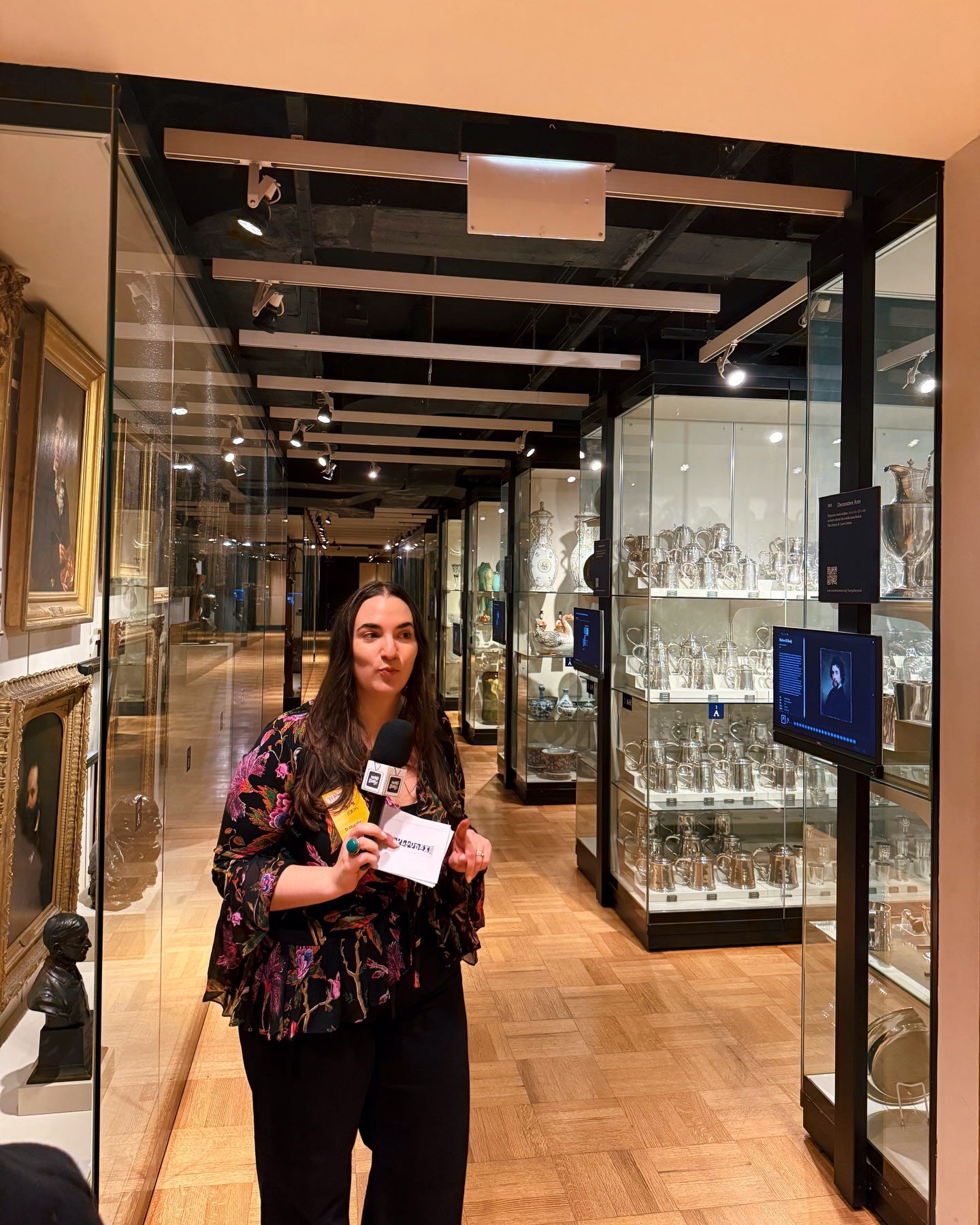
DM: A lot of people have not heard about it. This all started on TikTok because I go to the Met very often, and it was crazy to me that I didn’t know my way around. It’s humongous, with so many corridors, and it’s very easy to get lost. I challenged myself to learn the layout of the Met. I went consecutively for weeks with a map, mastering one hall at a time. Those videos started getting a lot of attention on TikTok, and the Met actually commented on one of them, telling me to check out Visible Storage. It’s a really incredible gallery in the American wing of the Met. It’s essentially a storage unit for things that didn’t make it into the permanent galleries. It’s organised by material. There’s an entire row of silver, rows of extra paintings, a section of furniture, ceramics, and glassware.
That video went viral—I had lifelong New Yorkers commenting that they had never heard of this room. I wanted to bring people there for fun, so I reached out to the Met to see if a tour guide could give us a real tour. They told me they don’t do tours of Visible Storage, which felt like all the more reason to do it. So I then curated a group of ten people, did some research, and acted as the tour guide myself. People walked away completely amazed. That inspired me to start doing tours of other places; I just did one for a really incredible dry cleaner workshop in Brooklyn, and this month I’m doing a tour of the Central Park Conservatory Gardens. I’m really into showing people things that are right underneath their noses.
ES: It’s amazing how good you are at putting yourself out there, but also to have those institutions reciprocate your interest.
DM: I think it comes down to storytelling. If you can figure out the right way to communicate things, people want to pay attention.
Dolly Meckler is a social media strategist and consultant. She lives in New York (specifically, the UES).