

Gutes Guterman: You have to be delusional about what you can accomplish
A conversation with the Byline co-founder

Welcome to Human Pursuits, the column that features need-to-know names and stories in media and other creative spaces. Today, writer, editor, and Byline co-founder Gutes Guterman, on her fear of heights, the importance of physical objects, what’s in a name, and working with people you love.
Gutes Guterman is a little hard to pin down.
I mean this mostly in a logistical sense. Between her full-time role as social media strategist for Air, the Creative Ops System, and running the popular new media publication Byline, which she co-founded in 2023 with Megan O'Sullivan, her schedule is, as the French say, stuffed to the gills.
But I also mean it in the sense of Gutes herself. The unconventional-yet-commercial way she thinks about stories and the world, the way she connects the micro and meta narratives, the way she surfaces and shares stories just as they’re beginning to solidify in the public consciousness.
Before she was a founder—before Vanity Fair or the New York Times came calling— Gutes wanted to be a sculptor, and this artist mentality still informs her perspective as both an editor and publisher.
Hell, it seems to inform her perspective on life itself.
Ahead of our conversation, I texted our mutual Friend Ali Royals for the inside scoop on Gutes.
“She is passionate about seafood,” replied Royals. “Loves Andy Warhol to death. Ask her about her newish giggling approach to life.”
Reader, I asked about almost none of that. But for good reason. We had much to discuss.
Our edited and condensed conversation touched on being a little bit delusional, what makes a great Byline piece, and more.
What’s in a name?
ES: I’m sure you’ve heard this before, but you really do have one of the best names in media. You’re like Prince or Madonna.
GG: Thank you so much. I fluctuate between wanting it to be a mononym and wanting it to be the same name twice. I like both.
ES: Stupid question, is it your actual name? Like, your parents saw their baby and named her Gutes Guterman?
GG: It’s not my government name…
ES: Oh!
GG: But it is New York Times official. The New York Times calls me Gutes Guterman, which is, in some ways, more difficult to make happen than legally changing your name.
ES: Laughs.
GG: It’s something I had to fight for because, early in my media journey, they would do “Gutes” in quotes. I would say, “That’s not my name.” And they were like, “Okay, well...” They kind of threw the rulebook at me and said: “Here’s all the things you need to do for it to be considered your real name in the Times.”
But then the next time I was featured in the Times, it sort of slipped in there. It was an editorial oversight, I think. From that point on, I could say, “You did it once; are you really gonna backtrack?”
ES: And so you’re Gutes in the paper of record.
GG: What’s also funny about my name is that there is a Spider-Man character named Gutes Guterman.
ES: I didn’t plan on this becoming a whole line of questions, but did you come up with this name? Like, where did it come from?
GG: It’s because last name’s Guterman. My friend Zans—who’s the only person I know who maybe has as crazy a name as me—came up with it 15 years ago, and it stuck.
ES: Are you from New York originally?
GG: No, I’m from the Bay Area. Near Palo Alto.
ES: You and New York seem like soul mates. I have to assume you always wanted to live there?
GG: It was the only option.
ES: You knew from a young age.
GG: Yeah.
ES: What was the first thing that you remember thinking about New York, or why you wanted to be there?
GG: I watched a lot of Project Runway, and they filmed it at The New School, so I went to The New School.
ES: Sick.
GG: But yeah, I’m so inspired by the city. I love it. I don’t imagine I’m leaving anytime soon, but who knows? I’m amenable. Laughs.
Media is the medium
ES: You’re a writer, but I get the sense that you are also editing and potentially commissioning a lot of Byline pieces yourself. Were you always interested in publishing and editing growing up? Were you idolizing media figures?
GG: All of my media background stems from being delusional and aspirational enough to launch my own things. I didn’t go to school for writing, journalism, or media. I went to school for sculpture. I thought I was going to be an artist. The people I looked up to growing up weren’t media figures—they weren’t people who ran magazines; they were people who had museum shows and were artists.
Being an editor is not something I thought out, because it’s honestly not a career path that I knew anyone could have. It wasn’t even in my peripheral. I’m an editor because I care about telling interesting stories with a particular point of view, and I will dedicate myself to anything that needs to happen in order to succeed. Editing is one of those things, and I genuinely do enjoy it. It’s kind of like a puzzle piece. Sometimes I enjoy editing more than writing because it’s like an analysis of something, but I am by no means traditional.
ES: Wow, I really admire that. I think that outsider perspective is probably your superpower, in a sense, because you’re not constricted to the rules or the standard operating procedures that might be hammered into people in the classroom or bullpen.
GG: I would consider it an advantage and a superpower, but I 100% hear the argument for it not being that.
ES: Do you still practise art at all?
GG: Not really. I approach everything with an artist mentality. “What does it mean?” I’m always asking people what something means, what the underlying structures are that make this thing possible, and how they are referenced. I’m a very meta-thinker. I’m also, at the same time, a very surface-level thinker and find a lot of inspiration in just very mundane stuff.
But no, I’m not a practising artist anymore.
ES: It kind of feels like your whole life is art in a certain way. It’s like everything you do is part of a big project. Laughs.
GG: Totally. The Drunken Canal, which is the project I started before Byline, started as an art project. We weren’t setting out to make a newspaper—or, we were setting out to make a newspaper, but we weren’t setting out to build a media empire or anything. I didn’t know what media was.
But I think you’re right that it definitely stems from treating everything like an art project, where media is the medium, and then you take it from there.
If it doesn’t exist physically, it doesn’t exist at all.
ES: What makes a great Byline piece, in your opinion?
GG: To me, a really great Byline story is a first-person essay with a really distinct point of view that has somewhat of an inner struggle or some sort of dilemma. There doesn’t necessarily need to be a resolution, but the writer is presenting themselves with a question. I’m thinking about this current issue. We have this one writer, Bea Isaacson, who wrote a piece called “Two Truths in a Body”. It’s about wanting to be a feminist and caring about the rights of all women, but at the same time wanting to be skinny and indulging in certain diet trends. It’s about her sense of inner struggle and having to reconcile with it. Asking “Can I really be a woman for other women if my self-worth rides on the size of my body?” That, to me, is a very successful essay, or a really great Byline essay, because it’s her first-person account of the situation. It’s not necessarily the account of all women everywhere, but I would hope that some women can identify with it.
ES: You seem to have a real knack for identifying emerging talent. How do you curate writers for Byline? Is it just friends and acquaintances, or are you simply getting great pitches?
GG: It’s definitely a mix of both. I think the best pieces, or the best issues, are when it’s a mix of us—like Megan, my co-founder, and me—seeking things out, and also helping people who have pitched, really pulling the best piece out of them.
I think we’re really good at it because we spend a lot of time online and see what people are talking about. I’m always out in the world, especially with Ali [Royals, Byline’s editor]. We’re literally always out and talking to people, so we know what’s happening in culture on a very casual level—not in a sort of regurgitated media sense of culture, but literally what people on the street are caring about and what everyone is saying. Because of that, we’re able to be really thoughtful with our commissions and say, “We know this person has been really into Transcendental Meditation lately; they should write something.”
Such great heights
ES: Random question: are you scared of heights?
GG: I’m terrified of heights.
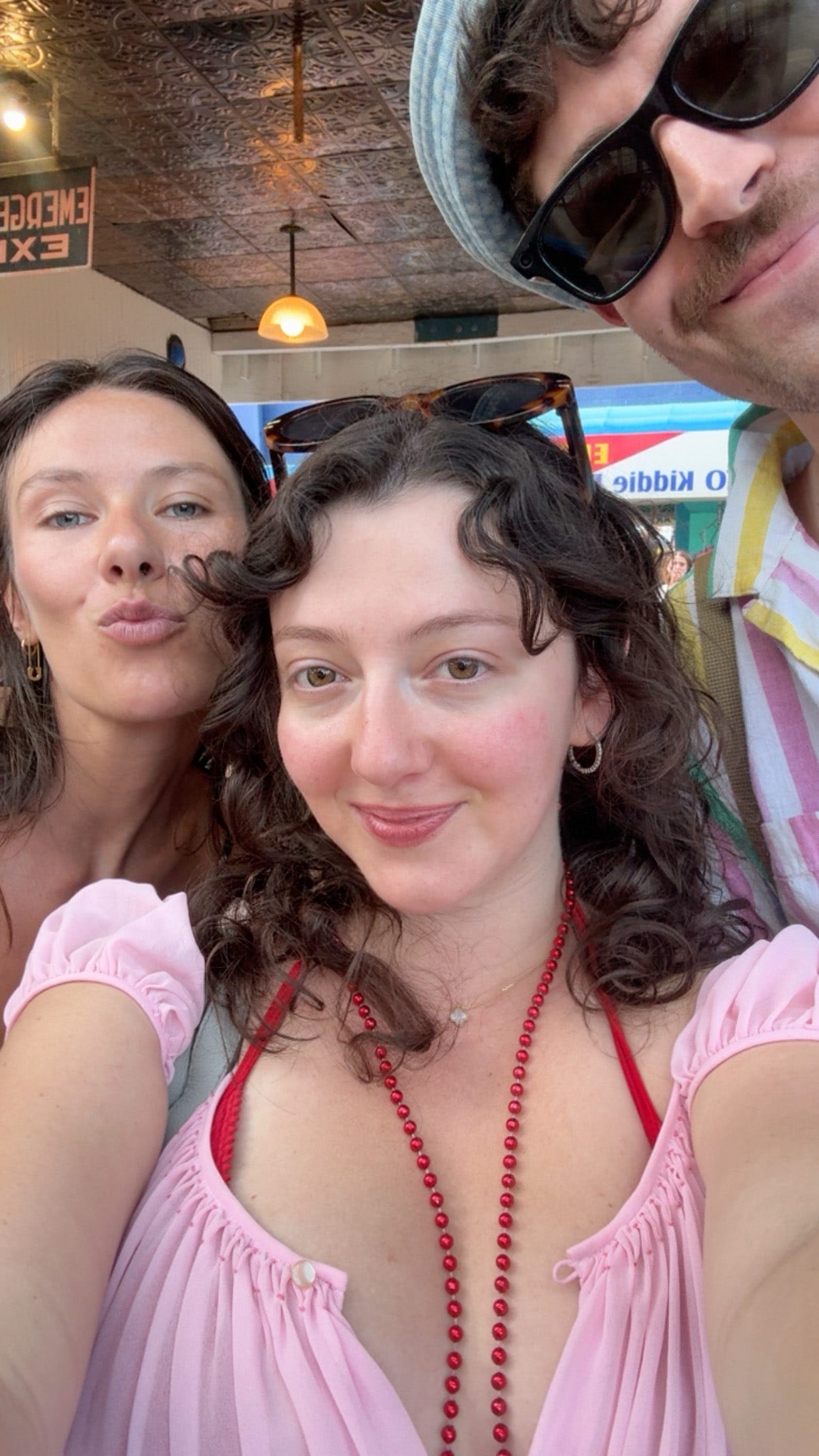
ES: Because I saw Ali’s story the other day. It was you at Coney Island.
GG: I’m literally terrified of heights. It’s actually funny you should ask this because I have a new show called “Fear of Heights”, where I interview creatives and marketers about their fears, while simultaneously trying to conquer mine.
ES: Oh, well, I’m happy I asked. Tell me more.
GG: This is a project I’ve been working on at Air. I was trying to think of ways that Air can show up in the world, and I was playing on the idea of “up in the air”. I thought, “God, I would hate to do all these high-up things because I’m so scared of heights.” So, yeah, I’m really fucking scared of heights, Ethan. Laughs.
ES: Where are you doing the interviews then?
GG: The first one was at the Empire State Building, which I had actually never been to. Or if I had, it was a repressed memory that I can’t access. The next one is going to be on the 37th floor of someone’s apartment building. Out on the terrace. And I think we’re just gonna progressively get crazier…
ES: Have you always been scared of heights?
GG: It has gotten worse with age. What’s funny is my mom has a really intense fear of heights. I was always a little wary of them—I could do it, but it wasn’t my interest. As I’ve gotten older, I’ve gotten more and more scared. I’m now in the phase of my life where I’m really fucking scared of heights. I haven’t really investigated it because it’s one of those things that crept up on me. All of a sudden, I was like, “Oh!” I’m realizing the feeling of your legs giving out or that you’re going to faint is not normal.
ES: You did seem pretty scared in that photo. Your eyes were closed!
GG: It wasn’t pleasant. I didn’t like it. And mind you, this was a Ferris wheel. Laughs.
ES: Gutes. C’mon now.
GG: It wasn’t even a real ride, but Ali and our friend Harry Hill insisted that we do the one the cages rock. I lost it.
ES: If you ever feel like doing a roadshow, you should know the CN Tower in Toronto has a giant glass floor.
GG: I will be taking the show to Toronto. Air has an office there. I believe you can also walk on the outside of it, right?
ES: Oh yeah. The EdgeWalk.
GG: I actually genuinely don’t know if I could do it. I think I would probably piss myself and start to cry. The thought of it makes me nauseous.
ES: How were you even able to conduct an interview in these conditions?
GG: For the first episode, I planned ahead and wrote down my questions, but I didn’t bring anything with me. I got up there and immediately forgot everything that I had prepped. I kept having to turn to my cameraman and ask, “What am I supposed to ask now?”
I think for the next episodes I will have some physical note cards just in case the fear takes over again.
ES: This might be a stupid question, but what’s the deal with Air? It seems like the company has relationships with a lot of New York media figures.
GG: Air is a creative operations platform, so we’re like a sexy Dropbox.
ES: Laughs.
GG: We take your files and light them up with AI, making them searchable, shareable, and scalable using features like facial recognition and version history. It's basically combining what Dropbox and Frame.io do together, but built specifically for creatives. Ultimately, it's a platform for all your visual assets—and we just have a really unorthodox marketing strategy. That’s why they hired me. I have no experience in B2B SaaS, tech, or anything. But our VP of Content, Ariel Rubin, who is one of my absolute favourite people, has a really distinct vision of how we break through. Because managing files is not that interesting, it’s not that fascinating. People aren’t talking about companies like Dropbox in cultural circles, ever. But the fact that Air, as a company, has managed to enter the cultural conversation is a testament to our marketing… We work with a lot of creators on a lot of wacky stuff because we gotta break through.
ES: How would you generally describe the split of your life between your office job with Air and Byline? I feel like you must be firing on all cylinders almost all the time.
GG: There are not enough hours in the day.
ES: And yet you’re still having fun. How do you manage it?
GG: I think I am just a really enthusiastic person who loves to have fun. I can’t imagine a world in which I’m not having fun; I think that’s just how I was programmed. When they were making me in the factory, they were like, “We’re gonna connect this girl’s fun wires and make sure they’re always on.”
I’m always having a good time. I’m really lucky that everything I work on is really fun, and that everyone in my life is supportive of all my various endeavours. My Byline team is supportive of my Air hijinks, and my Air team is supportive of my Byline endeavours. You have to be a little bit delusional about what you can actually accomplish, because if I were more grounded, I would be terrified. But I’ve simultaneously got my feet on the ground while operating 100 feet away, and I think that lets me do it all without fear.
You have to be a little bit delusional about what you can actually accomplish
ES: Do you feel like your delusions have scaled up as you have accomplished more and more?
GG: Definitely. I’m working on a book, and I’m working on a movie… I’m literally blocking out my calendar three weeks in advance for writing sessions.
ES: Can you tell me more about that?
GG: I don’t think so. It’s too early.
ES: I feel like that fearlessness is apparent even in the fact that you continue to work with print. Like, physical media has been a recurring facet of your career. Why does that interest you as either a medium or a project?
GG: I don’t know. I think if it doesn’t exist physically, it doesn’t exist at all… I want things that can live forever… And the best way to do that is to give it to them in a way that they can hold. I can’t imagine a world where I’m not making physical objects. I think that really stems, honestly, from my sculpture practice, and working with my hands, and being a very physical person who loves tangible objects. Maybe it’s because I like to buy magazines and I want to make magazines.
It’s funny to me when people say “Print is over, or that print isn’t what it once was.” I don’t see it as an additional offering or an option. To me, it’s non-negotiable. You have to make the physical thing… Take it all the way.
Creative friendships >>>
ES: We’ve never met before, but Ali had such nice things to say about you and the influence your friendship has had on her. It feels like you have surrounded yourself with many wonderful women. What do those relationships do for you, both in a creative sense and a personal sense?
GG: As I’ve gotten older, I’ve realised that my friendships are the most important thing to me. Everything that I’m working on could disintegrate and not exist, and I would still be just as happy because I’m surrounded by so many strong and brilliant women who let me do it. I also think I’m really lucky because most of my friendships are creative friendships—even if we’re not actively working on a project together, we’re always feeding ideas. I’m very much surrounded by women who want to support other women.
Everything I’ve worked on, I’ve always had a co-founder who has been a friend of mine, or a co-producer or partner who has been a friend, all of whom are women, and I can’t imagine going through this world without that… I would be so scared to go through this world alone and do all these things with all of the weight on me. By having this team of women around me, the pressure is alleviated; it’s more fun, and we’re able to rely on each other. It’s a really beautiful part of my life. The more I love people, the more I want to work with them, which I think is very capitalist of me. Laughs. I’ve been making a new friend, Rachel Bell, and we’re so kindred and alike, and so excited to see the other one win. We were talking about that, and I said, “We should start a podcast.” Then I thought, “Fuck, I’m so sorry that I’m turning this precious thing we have into an opportunity to monetise,” but it’s because I just love to work with people I love.
ES: Another stupid question, but have you ever tried to work on a project closely with a man? If so, what was that like?
GG: I have worked on a bunch of projects with straight men that have always been interesting, but have never materialised. I think that in working with women, there is a belief in one another that lets us make it happen. But I do have a lot of amazing males who have helped me on projects.
ES: “Amazing males.” Laughs.
GG: Yeah, like our web developer at Byline for a long time—he left recently, but you know what I mean? We couldn’t have done that without him.
ES: Totally. And of course we’re talking in the broadest of strokes.
GG: I’ve also had a lot of amazing creative collaborators who are gay men. My friend Owen Lang was a creative collaborator of mine for a very long time, and one of my favourite people. I think he understands me and understands the things I’m interested in more than anyone else. I always say Andy Warhol and Owen are the two people who think like my brain the best.
ES: I love Andy Warhol.
GG: I love Andy Warhol. I love the idea of a Factory; I love the idea of production. I’m a whore for monetization. I exist in a capitalist society, and I embrace it.
ES: I wish I were good at monetization. I need you to coach me.
GG: Laughs. Listen, I’m not great at it. Let the record show I have a full-time job, but I love to see people win and get their bag.
Gutes Guterman is the co-founder of Byline. She lives in New York.