Vaseline (Puberty)
On the Rio Audio Corporation and a radio host named Delila


Over the next few weeks, I’ll be sharing some personal essays as part of a larger, still untitled project.
This is the first essay.
The first time I felt truly unlovable was in the winter of 2001.
My parents had had enough of Ontario, and so, for reasons I only partially understand, they decided to retrace their steps, back across the Canadian shield, to the lonesome, crowded west, and Alberta, where my sister and I were born.
Thinking about it now, I see this is likely where things took a turn. Where I became a sort of perpetual dual citizen. Too western for the East and too eastern for the West.
My earliest years on the prairies had been formative in that sort of fundamental way that defines early childhood. Learning to walk and talk. ABCs and 123s. Pretty much all of my memories from that time occurred inside our family home, which had a wrap-around porch and was painted blue. Bouncing in a baby jumper, eating birthday cake, being scratched by the family cat. This is how I understood Alberta when we left.
When we came back, I somehow knew even less. Everything was new and interesting. Like how our suburb had a movie theatre within walking distance, or how the land was so flat that you could see downtown towers from the highway, 20 minutes north. My parents had scheduled the move for late August-early September, and I remember thinking the days felt longer than any that had come before. The sun lingered in the expansive sky longer than it did out East, as though it couldn’t find the horizon to dip below.
The biggest surprise of all, though, came months later when the dry cold set in. The first snowfall arrived around Halloween that year, and soon after, the skin on my hands and knees became dry and cracked. The area around my mouth was the worst, though. I had never experienced anything like it. I developed a bad habit of licking my lips and they quickly turned a dark shade of crimson. I needed moisture, but didn’t know where to find it. In vain, I started to run my hands under the tap, wetting my lips with my fingers. Soon, the redness crossed the demarcation line, blooming across the right side of my face, in a tight red blotch.
The upstairs bathroom of our new house had a skylight, and some mornings I would stand in front of the mirror in the cold winter light and gently pick the blotch with my fingernail. I felt so ugly that I couldn’t look myself in the eye. I had never much considered my looks. Suddenly, it was all I could think about. I dreaded going to school. I had made a few friends at the start of the year, but I worried they were judging my appearance. How could they not? None of the other kids looked like this.
I was six months into my new-old life, and I was utterly miserable.
At some point, my mom noticed my temporary disfigurement and prescribed me a wonder drug. Vaseline. I slathered that shit across the blotch every morning like clear coat paint on a Corvette. I worried that I was simply drawing further attention to my personal red scare. But there was nothing else to do. I had broken the moisture barrier. I needed to repair it.
Even though I had friends, I remember spending a lot of time alone as a kid, eating Life cereal and watching reruns with my sister. We’d park ourselves in front of the T.V. from about 3 p.m. to 5 p.m. every day, flipping between whatever was on TBS and Family Channel. Sometimes our scheduled programming would be interrupted by my mom, who would arrive home from work and want to watch Oprah. But for two or three years, that was the schedule.
Until I discovered Much Music.
Our house was always musical, but my personal interest in the form had only just started to solidify. Before leaving Ontario, I had somehow obtained a copy of Backstreet’s Back... Behind The Scenes, which showed the making of two Backstreet Boys videos, “Everybody (Backstreet’s Back)” and “As Long As You Love Me”. Something about seeing music—the celebrity, the costumery, the technicality—as opposed to just hearing left a deep impression on me. It was as if the world had cracked open. Suddenly, this abstract thing was not so abstract. Music looked like Nick Carter, it looked like Britney Spears, it looked like blink-182.
Much Music only furthered this sense of tangibility. Every afternoon, the channel would play its Much Mega Hits, and I would watch to have my mind simultaneously warped and blown. The videos that come immediately to mind are Alien Ant Farm (“Smooth Criminal”), City High (“What Would You Do”), Outkast (“Ms. Jackson”), and Nickelback (“How You Remind Me”), who had recently achieved escape velocity from Alberta and Canada to go internationally supernova.
Though hardly intentional on my part, I see now that I was often only close with people who could talk about music, even a little bit. My friend Brittany, who was really special to me, was the first person outside of my family, I think, who probably understood my taste. We talked about music in a way that seemed substantive for a 10-year-old. She loved Christina Aguilera’s Stripped, which I found absolutely terrifying. She was more mature than me in just about every way, and her admiration for that record proved it.
When I wasn’t watching music videos, I was illegally downloading mp3s off the internet. My dad had bought an iMac, and one day he showed my sister and I how to rip songs off of Limewire. We stole Smash Mouth’s “All Star,” and “Walking On The Sun,” and “Sugar” by The Archies.
Oh, and “Smooth” by Santana featuring Rob Thomas. I fucking loved “Smooth”.
Because my elementary school was a short walk away from our house, my sister and I would sometimes come home and eat lunch with my dad, who worked nights at the Edmonton Journal. Presumably, my parents knew other people who worked odd hours, but I never encountered another kid who went to bed with one parent and woke up with two. I might’ve felt strange about it, had I known any different, but I didn’t and so it was mostly fine. Sometimes we would come home and find him napping on the couch in the middle of the day. More adults should do that, I think. I have a friend who is currently sleeping 12 hours a night and she’s never seemed happier. Anyways, he was tired but he was steady. I know he really loved us because he would wake up every morning and make us breakfast and pack our lunch.
In the evenings, my mom would make dinner and then drive us around. I don’t remember listening to the radio much in Ontario, but Alberta car culture is a totally different beast. Suddenly the radio was everywhere. I remember sitting shotgun with my mom in our green Chevrolet Venture and listening to CBC’s The Current and Delilah, a five-hour call-in show hosted by a mononymous radio host of the same name.
Delilah would hear people’s deeply personal stories, and then, when they were done, pick a song that she felt best reflected their situation. It was pretty contrived, but also pretty amazing. Arguably better than most podcasts. And she had the audience to back it up. She still had an estimated 8 million listeners in 2016.
My mom and I would drive, and occasionally we would talk about the future. One time, we were driving and I told her I wanted to be an optometrist. I only said it because I thought it was like being a doctor, only easier, and I knew I wanted money. I knew I needed money to take care of people. People generally like the optometrist, I reasoned, and that really appealed to me.
As I got older, though, I realized that wasn’t what I wanted at all. I wanted to be a radio DJ. Like Delilah. Or the VJs who hosted Much On Demand, Canada’s take on TRL.
One day, my mom dragged my sister and me to a silent auction, and one of the items was a visit to a local radio station. The winner would even get a chance to speak on mic. Talk about divine intervention. My big break had finally come. We wrote down our bid — in pen so there could be no funny business — but when they called the winner, they said someone else’s name. I was incredulous. I sat down at our table and had a meltdown.
I cried harder about not being a DJ than I had about leaving Ontario, or my chapped lips, or any of the other little disappointments that had befallen me in my 11 years up until that point.
I must’ve been really annoying about it because the next thing I knew, the winning bidder had graciously donated their prize to me.
My mom had pulled some strings. I don’t know which strings, exactly. It might’ve been a friend who worked at the radio station, or one of the auction’s organizers. What I do know is that she knew how much the radio meant to me. How listening to other people’s songs and conversations made me feel connected to something. How it connected the two of us.
Clothing, fashion, politics, entertainment, technology. It was all starting to change then. And yet tweens and teenagers were able to preserve some innocence. It was a unique time. We all saw the Twin Towers burning on TV, and nightscope video of the ensuing invasion, but we also walked for Slurpees, and put a sprinkler under the trampoline on hot summer days, and fought in the ravines.
One moment you could feel entirely alone, and the other you could feel totally loved. And in this way, you learned what it felt like to be alive.
In the 2000s, there was still a feeling that the future was up for grabs. That whatever problems dominated a specific moment would ultimately prove fleeting. But it all started to unravel. I was a teenager in 2006 and 2007, and I remember suddenly feeling really worried about the economy and the environment and the war. I assumed these feelings would abate eventually, but they never really did. Instead, they stuck around for future generations.
In the 2000s, the future was up for grabs.
In the 2020s, it feels far more settled.
The aughts were organized.
The 2020s are almost predictably unpredictable.
I loved DJing. Or at least the idea of it. But it was never meant to be. Shortly after visiting the studio as the winning bidder, I learned radio folk work odd hours. 3 a.m. alarms, graveyard shifts. We broke up almost immediately. A midday nap can only take you so far.
Music was more of a forever thing. But even then, our relationship was complicated.
For my 13th birthday, I asked my parents for an iPod, but they were still $800 CAD, and they (understandably) said no. I was pimply, and greasy, and gangly, and I really thought I had everything figured out.
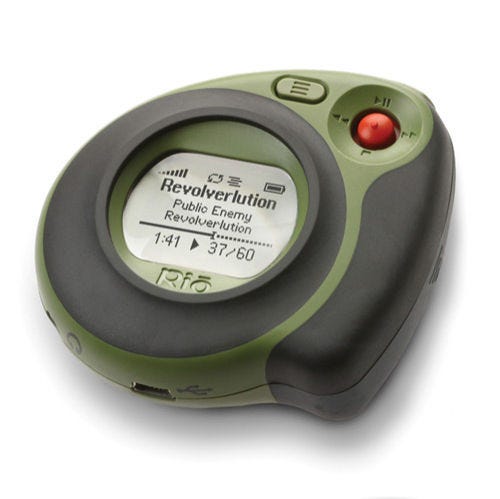
As a consolation, they bought me a Rio Cali. This little black and green mp3 player. It had 256 MB of memory, which I quickly filled. It worked like a charm, except when it was really cold, and it was Alberta, so it was always really cold. I would walk across the empty, icy fields behind my house, listening to Jimmy Eat World and Death Cab For Cutie, and staring at the moon and I would try really hard not to lick my lips, and I would feel these feelings that I am just now learning to properly describe. Because it wasn’t actually love. It was an approximation. An IOU written on a Valentine.
For a long time, I thought that was enough — which tells you something about me and next to nothing about the now-defunct Rio Audio corporation.