

Geoff Rickly: I see myself on the spectrum between Kurt Cobain and Rihanna
Part 1 of my conversation with the author and Thursday frontman


Welcome to Human Pursuits, the column that features need-to-know names and stories in media and other creative spaces. Today, Geoffrey Rickly on brewing technology, offensive musks, body dysmorphia, his favourite Pisces, and more.
Geoff Rickly’s reputation precedes him.
And, okay, fair enough. You don’t front an influential post-hardcore outfit for more than two decades without your public image calcifying a little bit.
But if your knowledge of Rickly is limited to his work in Thursday—to the soaring vocals of War All The Time and the swinging microphones of Warped Tour—then I would argue you don’t actually know him at all.
Because while he is emo, he is also kind, and funny, and a little bit eccentric. A Pisces man in every sense of the word.
Indeed, twenty-odd years into an already illustrious career, I would argue Geoff’s work has never felt more urgent or necessary. His first novel, Someone Who Isn’t Me published by Rose Books reminds me at times of Chuck Klosterman, Charlie Kaufman, and Allen Ginsberg, blurring the lines between memoir and fiction, trippy drug fantasy and sobering reality.
His new Substack, which you can subscribe to here, is just as gripping, featuring serialized short stories about his 25 years touring with Thursday, essays about hope, loneliness, gooning, and the algorithm, and demos for upcoming projects.
And so, we had much to discuss.
Our edited and condensed conversation, which spanned more than an hour, touched on being a dilettante, getting weirdly strong, and breaking through the hardcore ceiling.
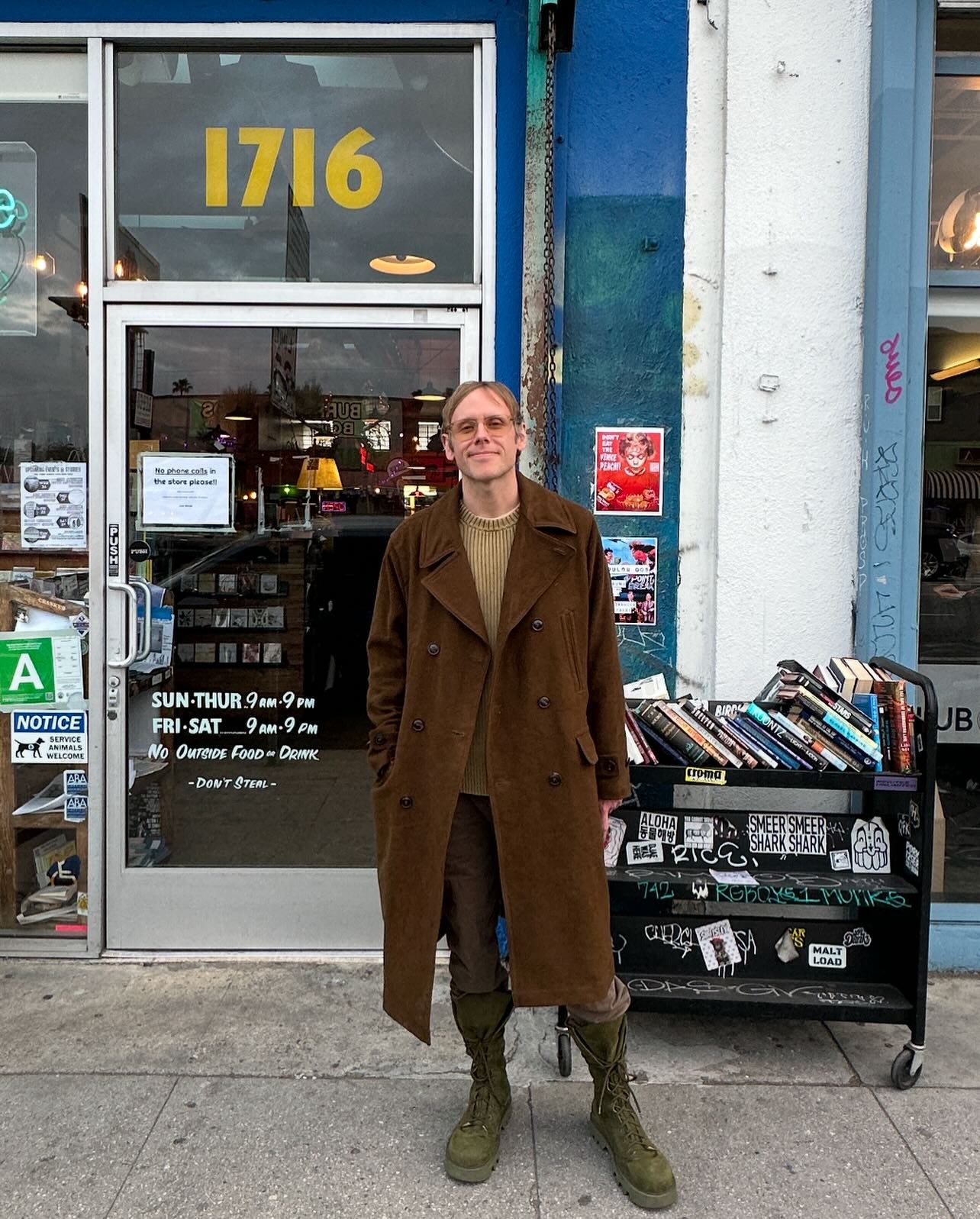
ES: You mentioned you’re an early riser. How early are we talking?
GR: At home, I’m usually up sometime between 5:30 a.m. and 7 a.m. It depends on the day before. 6 a.m. is probably my average time, I guess. But I wake up naturally. From there, I have some fun with the coffee ritual, and I pretty much immediately sit down and start writing after that.
ES: Wow, 6 a.m. with no alarm clock is some military shit. What’s your coffee ritual?
GR: As many addicts do once they get sober, I’ve seen my addictive personality touch other corners of my life. For a while, I was really trying to master Aeropress. Then it was pour-overs. I had a Breville espresso machine for quite a while because I had a therapist who tried to convince me to quit coffee. She thought it would help my anxiety, and when I was like, “I’d rather die,” she gave me her brand-new Breville espresso machine. She had gotten it as a wedding gift, but had convinced her husband to give up caffeine, so I was like, “I’ll take it.”
ES: No way.
GR: I tried to master getting a good shot of espresso. I found that with a lot of the pour-overs, I would go through the whole bag before I’d get a good cup dialled in. Recently, I got the Fellow machine called Aiden, which does pour-overs. I swear by that thing. I love it because they do these drops where they programme the barista’s recipe for the coffee into the machine when you get the bag. It’s better than any other pour-over.
ES: Sorry, what?
GR: Well, every week they have an offering of a coffee—they call it their drops—and it’s some great roaster like Sey or La Cabra. If you want a bag of that, then you just text them the number of bags you want. It comes in the mail, and by the time you get it, your machine—which is on Wi-Fi—has that roaster’s recipe loaded for how to make the perfect pour-over with that particular bean. You grind the coffee to specification, put it in there, and it makes the proper amount of pours with the different declining temperature profiles.
ES: Dude, you’re really in the weeds.
GR: I like it because I will inevitably mess up one of those details. Like, “Oh, I waited 10 seconds too long for the second pour,” or, “My second pour was hotter than my first.” I can’t believe how much better the automation makes my coffee taste. There were beans that I thought were pretty bad, which I now realize I was preparing incorrectly.
ES: Did you ever work as a barista?
GR: No, it’s such a hard job to get in New York because they pay so well. Usually, you need to do training to get them. I’ve worked in kitchens, but in more of an unskilled labour capacity… I worked at a place called Bon Chovie for a while. I was frying anchovies.
ES: I can only imagine what you must have smelled like coming home after that. Laughs.
GR: I’ve had a lot of blue-collar jobs, and the hardest one, by far, was working in a kitchen. It was unbelievable. It was literally backbreaking work. I’m 6 feet tall, and so every work surface was too low. I’d get home and lie down on the ground just trying to straighten my back out.
ES: 6 feet is about as tall as I’d like to be. I’m 5’10”, which feels like a sweet spot. Big enough to turn heads but not so big that you can’t ever get comfortable.
GR: You’ve got tall privilege, but you’re not called out for having tall privilege.
ES: Exactly. You’re famously a bit of a perfume guy. What scent are you wearing today?
GR: My relationship with perfume is kind of similar to coffee, where I went all the way through the obsession, and now I’m on the other side. I used to do a scent in the morning and shower around noon so I could get a second scent for the day. Now I have 4 or 5 each season that I bounce between. This morning I’m wearing Marlou Doliphor. It’s this clean laundry musk that smells human and comfortable. I have other ones that are more offensive.
ES: How much does that cost?
GR: Maybe $110.
ES: Not bad.
GR: It’s reasonable for a really nice one. I also have a bunch of cheapies from the drugstore that are $30 or less. There’s a bunch of really good ones out there.
I also really like some absurdly overpriced things—sandalwoods distilled by Japanese incense masters and stuff like that. I dipped my toe in those waters, and I’ve resold a bunch of the ones that are too expensive because it’s just too much.
I see myself on the spectrum between Kurt Cobain and Rihanna.
ES: Who put you onto the scent game?
GR: I would probably blame my parents for that. My mom’s a fashionista, and she also wears really classy perfumes. She wore Robert Piguet’s Fracas, which is this classic tuberose scent. She wore some interesting carnation stuff when I was a kid. She had great taste. My dad is an inorganic chemist. One of the jobs that he worked at was Reckitt & Colman, making Air Wick air fresheners.
He worked with IFF and Firmenich, the scent conglomerates, and he would say, “I’m a chemist, but some of these chemists are artists.” He told me about time curves, evaporation, volatility of compounds, and how the heart, base, and top notes work together. He piqued my interest. By the time I was in Thursday, I was wearing pretty light, fresh scents, just because we were so often going days without a shower. Anything minty that felt fresh and clean was my go-to for a dozen years.
After Thursday broke up, I started wearing Tuscan Leather by Tom Ford for a while. Then I had a job at a PR agency where the boss was the first person I had ever met who wore Santal 33 by Le Labo. I was like, “Wow, he smells great.” I had a patchouli from Le Labo that I really loved. It grew from there; when I got sober 8 years ago, I got really into it.

ES: Do you ever blend scents? Or are you a purist?
GR: If you have materials, you can layer them. I’ll layer sandalwood and oud and maybe a little bit of ambergris or frankincense. As far as perfumes, though, if you respect the perfume and you like it, then you want to hear what the perfumer’s trying to say with it clearly, rather than muddying the waters. To me, mixing perfumes is like playing two songs at the same time. There are situations in which you might get a cool effect, but it’s certainly not like listening to music.
ES: You want to receive the message as intended by the artist.
GR: Yeah, I enjoy the journey of perfume. Really great perfumes will have the three major acts, and then there’s a bunch of micro things that happen. Some are totally prismatic and can change minute to minute with the temperature, the atmospheric pressure, and whether it’s dry or moist out. I really enjoy the surprises that come with that.
ES: Would you say your sense of smell is one of your strongest senses?
GR: Some people can smell everything, and they’re also super tasters; they just have more taste buds. My partner, who does a food documentary series, is a supertaster—she had it tested—so she picks up on things that I never pick up on when we’re out together, and I think she’s probably the same for scent.
But I do think you can develop your appreciation of scent. The way your brain sorts scent is really interesting. It’s like your visual stimulus in some ways, where your brain’s always filling in missing pieces. With scent, I think it’s even more likely to fill in missing pieces because the reference is so much less stable than when you see something. Scent is like when you see something in passing on a billboard, and later on, you’re trying to reconstruct it…
There is a whole group of scents that smell like piss to Americans but smell normal to other countries. They don’t have any pissy notes in them, which is common in perfumery, but they only have clean notes. Perfumers can’t figure out why everybody in America thinks they smell like piss. It’s because we use those same scents in bathrooms, and your brain literally fills in the missing ingredient… Your brain is filling in stuff that’s not there.
ES: I was reading an old interview with you from 10 years ago, and they referred to you as a bit of a polymath. You have a lot of interests, but you also seem to actually know things about them, which I admire as a fellow Pisces. Are you lurking on perfume message boards or something?
GR: I do lurk on message boards. Sometimes, when I was a kid, if I was interested in something, my dad would be like, “Oh no,” because he knew what was coming. He knew that now this was going to be my personality for 3 years.
ES: Laughs. “Oh no.”
GR: So I do dive deeply. It’s a strange thing, though. I had somebody recently say that I’m a know-it-all, and I was thinking it’s really funny because I dive really deep, and then I forget almost everything. I’m more of a dilettante than a polymath, I think. I just jump in over my head every time.

ES: Do you feel like a Pisces? You seem emblematic of that star sign to me.
GR: Laughs. I have a hard time denying signs and horoscopes because you could look up Pisces in the dictionary and see my face next to it.
ES: Who are some of your favourite Pisces?
GR: I see myself on the spectrum between Kurt Cobain and Rihanna. Laughs. There are a lot of Pisces that I really admire, and there are even inanimate things that are Pisces that I really relate to. Gravity’s Rainbow is a Pisces book. It starts in the House of Pisces, and I’m like, “Makes sense.” The Downward Spiral came out on my birthday when I was 15. There are things where I’m like, “Well, you’re not a Pisces, but you made a Pisces thing, and now I know that you’re secretly a Pisces.”
ES: Laughs. You’ve got a birthday coming up. How are you with making plans? I feel like I get analysis paralysis with any sort of major function. I dream big while also failing to give myself enough time to actually do anything.
GR: The tension in my house is that my partner’s a planner, and I just like to be. It’s exacerbated by my job, which is always doing stuff, being social, and being out every night of the week. It often gets to the place where my birthday’s coming, and she’s like, “What should we do? Here are the 5 things I want to do.” It gets to the point that every night of my birthday week, I have different plans with people, and I’m like, “Ugh.” She’s like, “You want to see them?” and I’m like, “Yeah, I do.” I want to see them, but I also want to do nothing.
Doing nothing presents its own set of challenges, though... Last year on my birthday, I think I was in Berlin. We had a show, and they brought me a cake on stage, which was great, but it was a show day, and I was busy as hell. I figured, “Let’s celebrate on the next day off.” But then on the next day off, everybody went to get coffee without me because I was finishing my laundry.
ES: Oh no. That’s where the crazy comes out.
GR: I was so heartbroken. They know I’m a coffee guy, and I felt like they all abandoned me and nobody cared about me on my birthday.
ES: That makes me want to cry.
GR: I may have cried a little. And then they decided where we should have my birthday dinner without me.
ES: Cancel the tour. I’m out.
GR: I was like, “I’m not going to go to dinner.” Norman from Texas Is the Reason, who plays with us, talked me down gently, in the way that only he can. He’s like, “If you don’t want to go, you don’t have to go, you should just enjoy yourself, but I think everybody really loves you and wants to see you. And, you know, earlier was probably a misunderstanding.” I went along grudgingly.
ES: I love how Norman basically gentle-parented you. You’re, what, 38?
GR: 46.
ES: Damn. Drop the skincare routine. You’re looking dewy.
GR: It’s funny, everybody’s been saying that recently. I’m just moisturising. I started doing skincare last year. Just a little bit of Kiehl’s.
ES: For my birthday, my wife treated me to this skincare procedure called an IPL, which shoots hot, white light at your face and surfaces all the sun damage. It turns your sunspots into little flakes that basically blow away. Very satisfying.
GR: I’m at the age where I’m starting to embrace getting older, but I don’t necessarily look much older. I’ve gotten really in shape in the last few years. My goal was to be in shape by the time my book came out, so everyone would be like, “Wow, look how good he looks.” I didn’t do that because putting out a book is so much stress, but I wound up doing it after. I don’t think it’s halted aging, but it’s made it less of a big deal.
ES: That would’ve been a pretty good bit.
GR: Another writer, Jordan Castro, did kind of what my idea was. I thought it would be insane if I showed up at the first reading completely ripped. Like, bulging with muscles. Jordan did it, and then he wrote a book about it… I thought about taking steroids... I thought it would be surreal, but then someone suggested that doing it for the bit, maybe isn’t worth it.
ES: I would hate to see you taking notes from Clavicular.
GR: I’m not a Clavicular fan, but I do think doing meth to be skinny is so relatable. I remember when I was trying to get off heroin, I had a friend who had gotten off it earlier. I told him, “Every time I get a month or two clean, I get so fat.” He said there were years when he couldn’t quit because he didn’t want to be fat. On heroin, you get so skinny because you have no desire to eat. It’s funny that you’re balancing this existential and real problem against something so meaningless to everybody in your life.
ES: The body dysmorphia of the 2000s alternative scene really isn’t discussed nearly enough. The guys were wearing size 26 jeans, and no one had any questions.
GR: It’s funny because I look back at pictures of myself and I was too skinny. I just remember that at the time, I felt so fat. I never reckoned with the fact that it was hard for me to see people taking my picture all the time. Thursday had a very unexpected rise to fame. We’ve settled into a comfortable spot now—highly influential and beloved by cerebral elements of the fandom—but not the leading band by any populist metric.
That’s probably where we always belonged, but because we were doing something different before everyone else, there was a moment where we were the band to watch—sort of like Turnstile is now. We were selling out 5,000 capacity theatres, right at that point of being as big as you can get without being a household name. It happened a year into Full Collapse being out. That record sold 700 copies the week it was released; it was not a hit. Then all of a sudden, boom, it was. None of us knew how deal with it; there was no PR training.
You can be a big band in hardcore now. At the time, that didn’t really seem possible. There was a ceiling. If you had 800 people, you were a superstar.
ES: And you were pretty young, right? It’s a young age for you to be perceived at a national level.
GR: We wrote Full Collapse when we were 20. It came out when we were 21, and we were famous by the time we were 22.
ES: It’s inconceivable now because 20-year-olds have access to the internet, but in the 2000s, you were basically civilians. You went from having no profile to being on MTV.
GR: It was crazy. We were still playing basements. I love How Long Gone, and Chris Black used to do shows in Atlanta—I think we played his kitchen to him and maybe two other people literally a couple of months before we were selling out 5,000-cap venues. It was a weird change. There were people living in that house who didn’t come out of their rooms to see us. They were like, “We’re okay.” They wouldn’t watch us because they’d never heard of us.
It’s not like we came out of nowhere; it was our second record, I put on shows in New Brunswick, and we had toured a ton playing backyards, roller rinks, and laundromats. Everywhere that a DIY band could play. And we were making friends, but we weren’t necessarily picking up fans… You can be a big band in hardcore now. At the time, that didn’t really seem possible. There was a ceiling. If you had 800 people, you were a superstar.
Part 2 will publish Sunday. Subscribe here to get it directly to your inbox.